

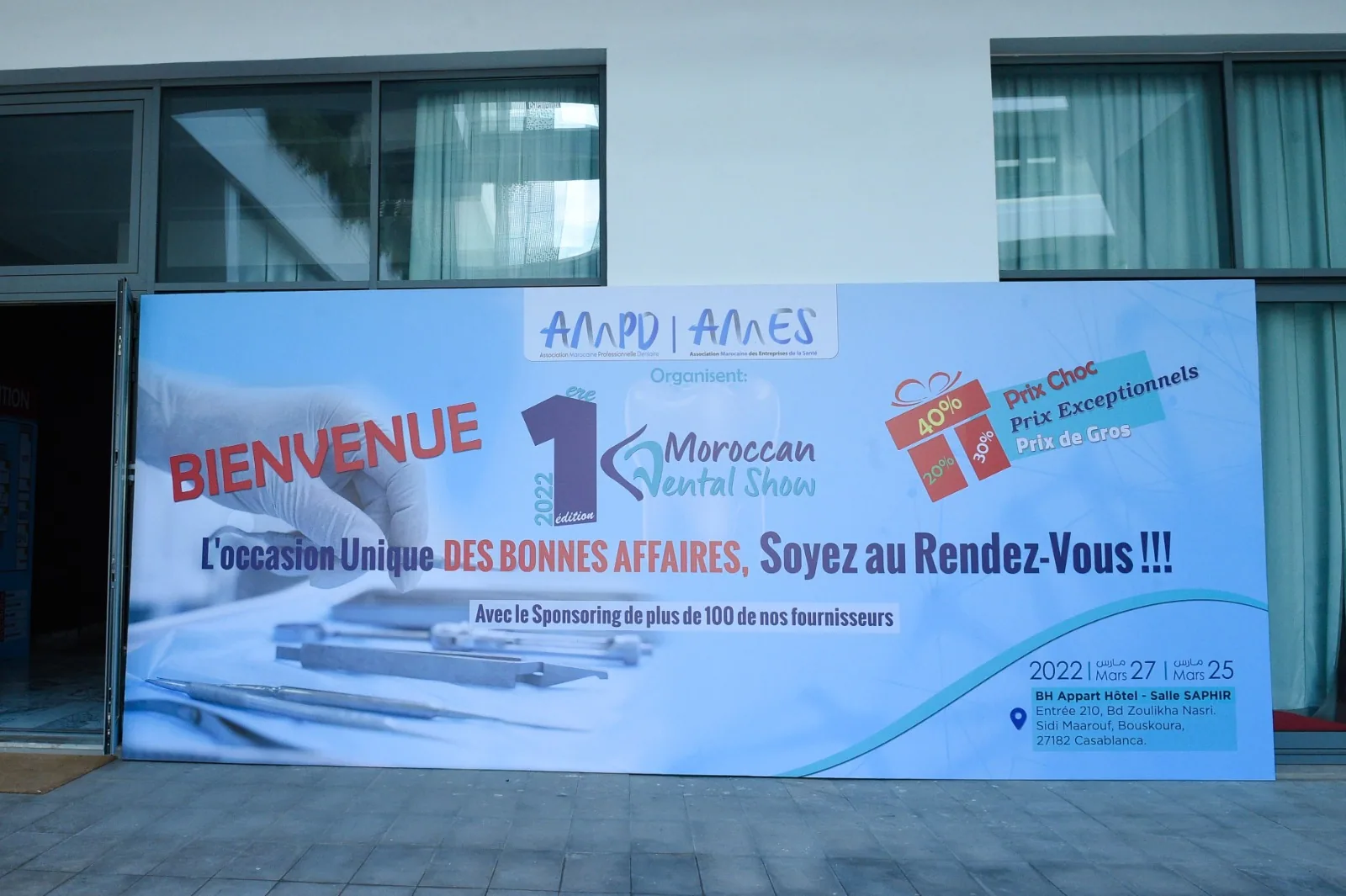
Start with where it will hang
Before discussing material, describe the exact place where the graphic will be seen: a facade in sun and rain, an indoor window, an office wall, a trade show aisle for three days. Duration and exposure decide almost everything.
A medium meant for a three-day show does not need to be the toughest. A facade banner left up for a year, on the other hand, must cope with UV, wind and temperature changes without fading or peeling.
Banner: the safe outdoor choice
Printed on flexible PVC, the banner is the most common answer for facades, building sites and long signs. It is tensioned on a frame, fixed with eyelets or pole pockets and handles outdoor conditions well.
Its weakness is movement: poorly tensioned, it flaps in the wind and distorts. Allow eyelets every 50 cm and fixings suited to the wall. Indoors it remains useful for a stage backdrop or a stand background.
- Durable outdoor: 510 g banner, solvent or latex print.
- Temporary indoor: lighter banner on a frame.
- Installation: eyelets, pole pockets, rails or bungee tension.
Adhesive vinyl: for smooth surfaces
Vinyl is applied directly to glass, a door, a panel or a vehicle. It is the medium for window wraps and lettering. It gives a crisp cut shape and a very clean finish, provided the surface is smooth and degreased.
On a shop window, micro-perforated vinyl (one-way vision) lets you see out while showing a dense graphic from the street. On a vehicle, cast adhesive with lamination resists repeated washing better.
- Windows and doors: permanent or repositionable adhesive.
- One-way vision: keeps visibility from inside.
- Vehicles: cast adhesive plus lamination, fitted by an installer.
Rigid PVC: stability and finish
Foam PVC, rigid PVC, acrylic or aluminium composite: rigid boards give a panel that does not distort. This is the choice for signs, wayfinding panels, totems and displays.
Rigid costs more per square metre and is harder to transport, but it installs straight, cleans easily and lasts. For a sign seen every day, the price difference is almost always justified.
Budget, installation and a checklist
For the same area, expect rising prices in this order: banner, then vinyl, then rigid. But the real cost includes installation and service life. A badly fitted banner replaced every six months costs more than a rigid panel installed once.
Before you decide, check these five points with your printer:
- Exact location and exposure (sun, rain, heat).
- Planned display duration.
- Mounting surface: smooth, flat, clean, accessible.
- Available fixing method (wall, rail, frame, window).
- Viewing distance: it sets the useful file resolution.
Still unsure between two media? Send us a photo of the location: we will answer with the right medium and a quote.